Skip to content
Use casesBroadcast & virtual production

Specify for the sensor, not only the eye.

How to specify a broadcast LED studio or virtual-production wall for refresh, moiré, shutter speed, genlock, colour and camera distance.

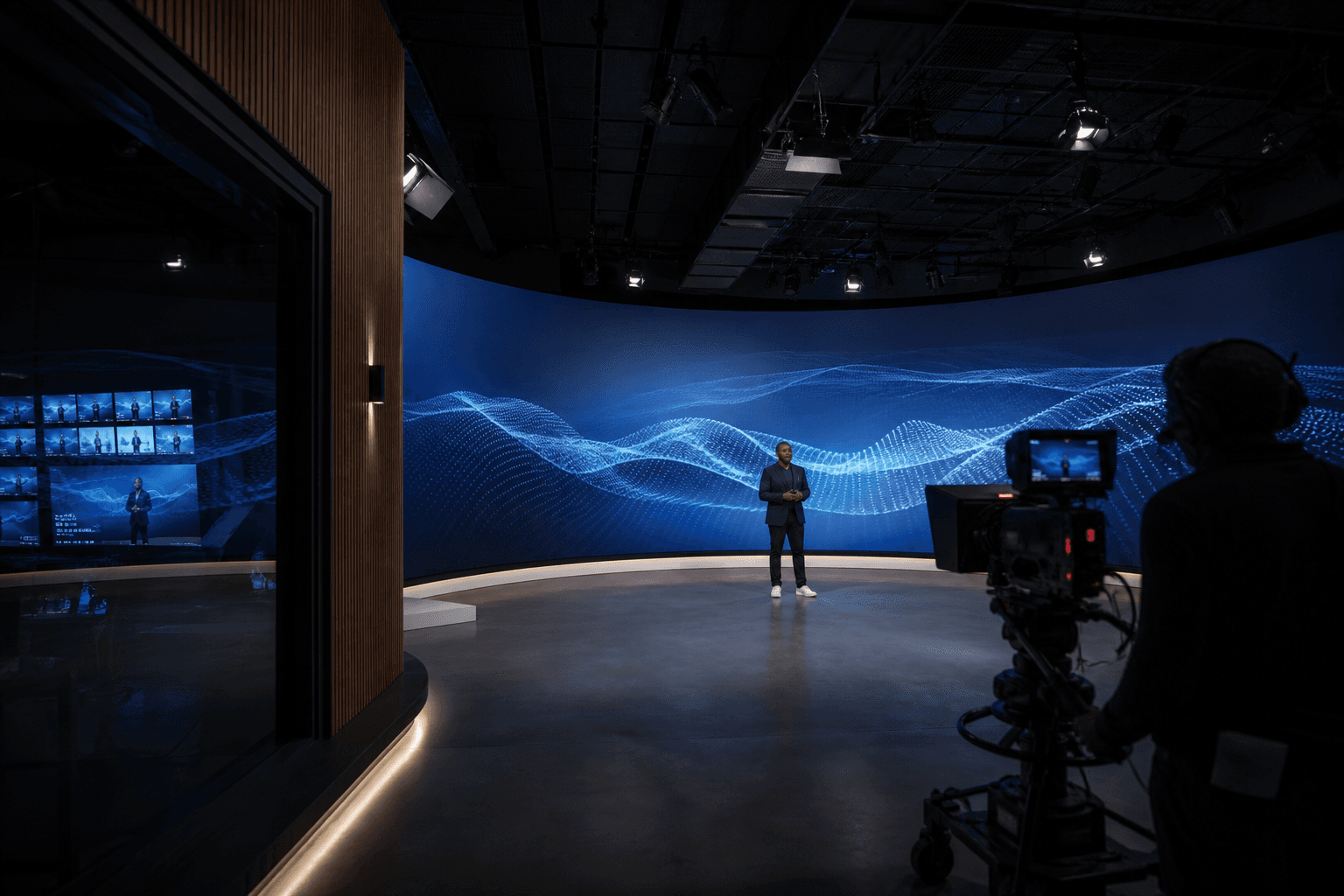
Broadcast presenter in front of a curved fine-pitch LED studio wall

Starting verdict

Begin with Nano P0.9–P1.5 at 7,680 Hz visual refresh, then prove it with the exact camera, lens, distance, focus and shutter combination.

Visual refresh
≥ 7,680 Hz

Verify at fastest production shutter

Starting pitch
P0.9–P1.5

Lens and focus set the moiré limit

Colour
Calibrated in situ

Target the production pipeline

Timing
Genlocked

Camera, processor and render aligned

01

A clean datasheet can still produce a dirty frame

Refresh rate, scan pattern, frame rate and shutter interact. Test rolling bars, tearing and brightness gradients at the fastest exposure the production may use. Then move the camera through its intended distances and focus pulls to find moiré risk.

Do not approve a wall from phone footage. The production camera and signal chain are the test instruments.

02

Colour belongs to the complete pipeline

Factory calibration is a starting point. Studio lighting, camera matrices, processing, render colour and the chosen broadcast or cinema target meet in the photographed result. Commission with scopes and the production team present.

Operate well below peak output where possible. This improves black level, heat, headroom and consistency.

03

Virtual production is a timing system

An LED cabinet does not deliver tracking, genlock, frame remapping or render latency. Assign one systems owner across camera, processor, tracking and render so faults are not passed between suppliers.

Questions before specification

The useful answers.

What refresh rate does a broadcast LED wall need?

7,680 Hz is a strong starting requirement for demanding studio use, but an on-camera test at the real shutter speed remains mandatory.

What causes moiré on an LED wall?

Moiré occurs when the camera sensor sampling pattern interacts with the LED pixel grid. Pitch, focus, distance, lens and sensor all influence it.

Is every broadcast LED wall suitable for virtual production?

No. Virtual production additionally requires coordinated timing, tracking, rendering, processing and colour management.