Skip to content
—Use cases / Field guide

Start with the room.
Not the screen.

Six environments. Six different reasons to use direct-view LED—and six different ways to get it wrong. A visual guide to the experience first, then the engineering that makes it possible.

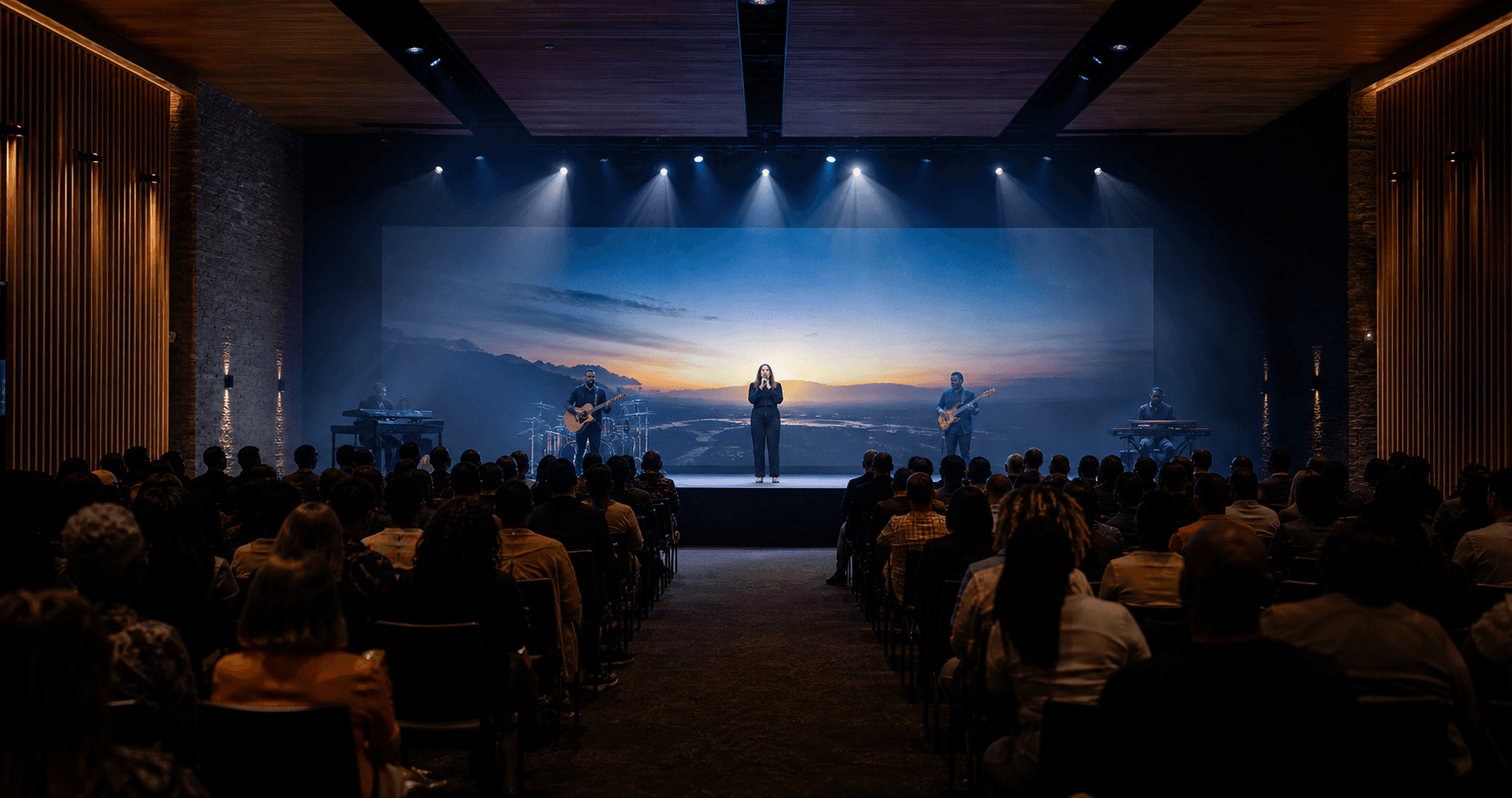
Contemporary church sanctuary using an integrated LED wall

The experience test

If the audience remembers the screen before they remember the moment, it was too loud.

01Churches & houses of worship
Contemporary church sanctuary with a wide LED wall behind a worship stage and congregation
Churches & houses of worship

Support the moment. Never become the moment.

The screen has to carry lyrics, live camera and atmosphere for every seat in the sanctuary—without making a reflective room feel like a sports arena.

A worship wall lives through extremes. It is almost black during a quiet address, bright and colour-rich during music, then immediately becomes a clean IMAG surface for the people at the back. The best installation does all three without calling attention to the technology between them.

Start with the furthest and nearest seats, then measure the daylight that reaches the stage. A wide 16:9 canvas is familiar, but a lower architectural format often integrates more naturally behind a platform and leaves room for lighting, musicians and sightlines. Front service access matters because there is rarely useful space behind the wall.

The deciding specification

Contrast under house light—not the peak-nit number on the brochure.

Typical pitch
P1.8–P2.6

Driven by the closest regular seat

Service level
500–900 nits

Usually below 50% drive indoors

Architecture
Front service

Quiet, tool-free module access

The honest caveat

A bright wall cannot repair poor camera placement or uncontrolled front light. Design the lighting, cameras and display as one visual system.
02Schools, universities & auditoriums
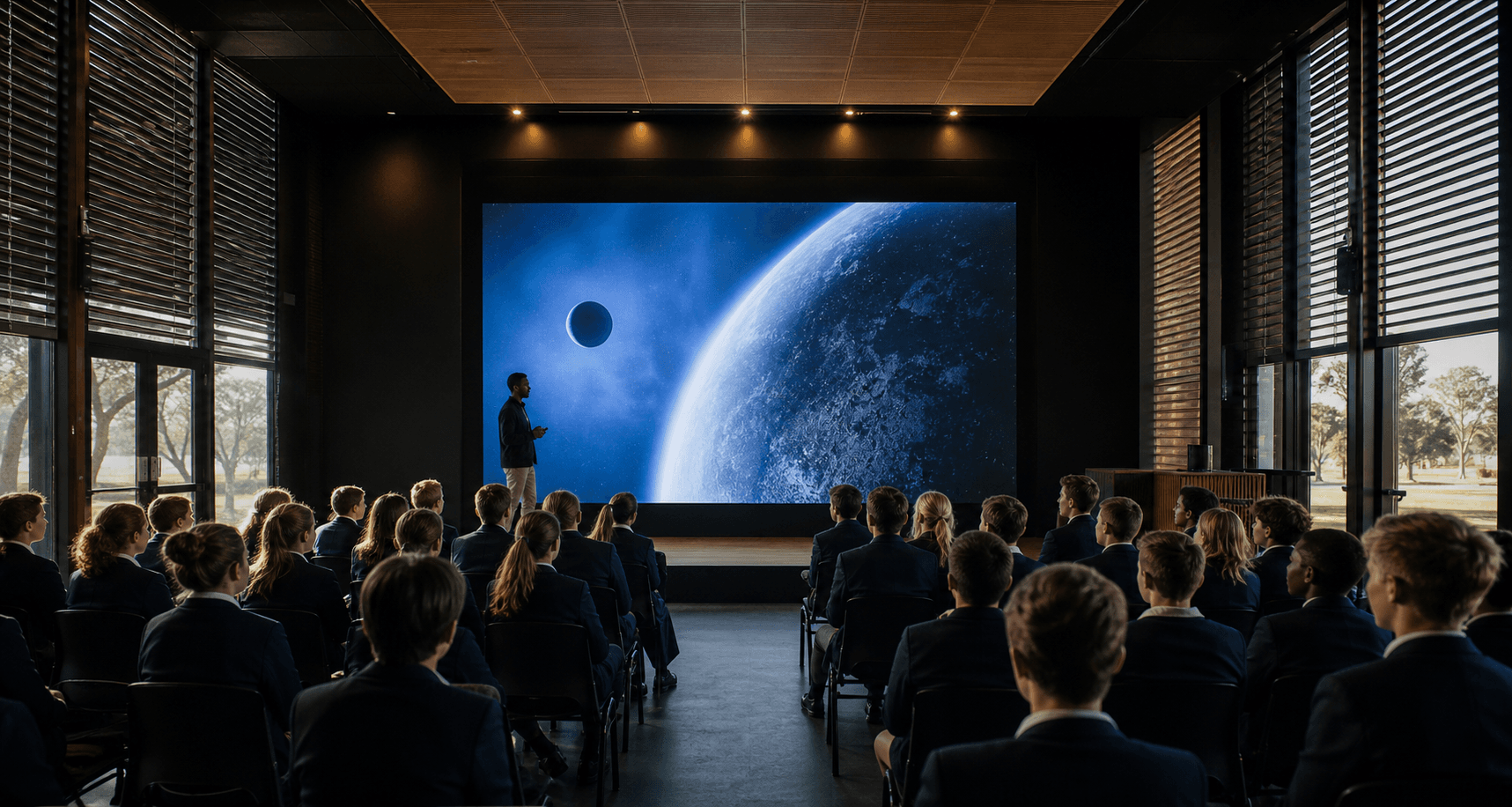
South African school auditorium with students viewing a large LED teaching wall
Schools, universities & auditoriums

Make the back row feel like the front row.

A learning display succeeds when diagrams remain legible in daylight and every student sees the same detail—without the room being redesigned around a projector.

Lecture theatres are long, bright and unforgiving. Projection loses contrast as soon as the blinds open; consumer displays become a patchwork of bezels at the size the room needs. Direct-view LED gives the lecturer one continuous, emissive canvas with no throw path and no shadow when somebody walks in front of it.

Resolution should follow the content, not fashion. Dense spreadsheets and small interface text need more pixels than video or large teaching graphics. In multipurpose halls, protect the lower edge from impact and specify simple source switching so the wall does not require a technician for every assembly.

The deciding specification

Legibility from the furthest seat at the room’s normal daylight level.

Typical pitch
P1.8–P2.5

Match to text size and closest seat

Canvas
16:9 or 21:9

Teaching plus confidence content

Protection
COB / GOB

For reachable or multipurpose stages

The honest caveat

If the room is small, controlled and genuinely dark, a good laser projector may still be the better use of the school’s budget.

03Outdoor concerts & touring
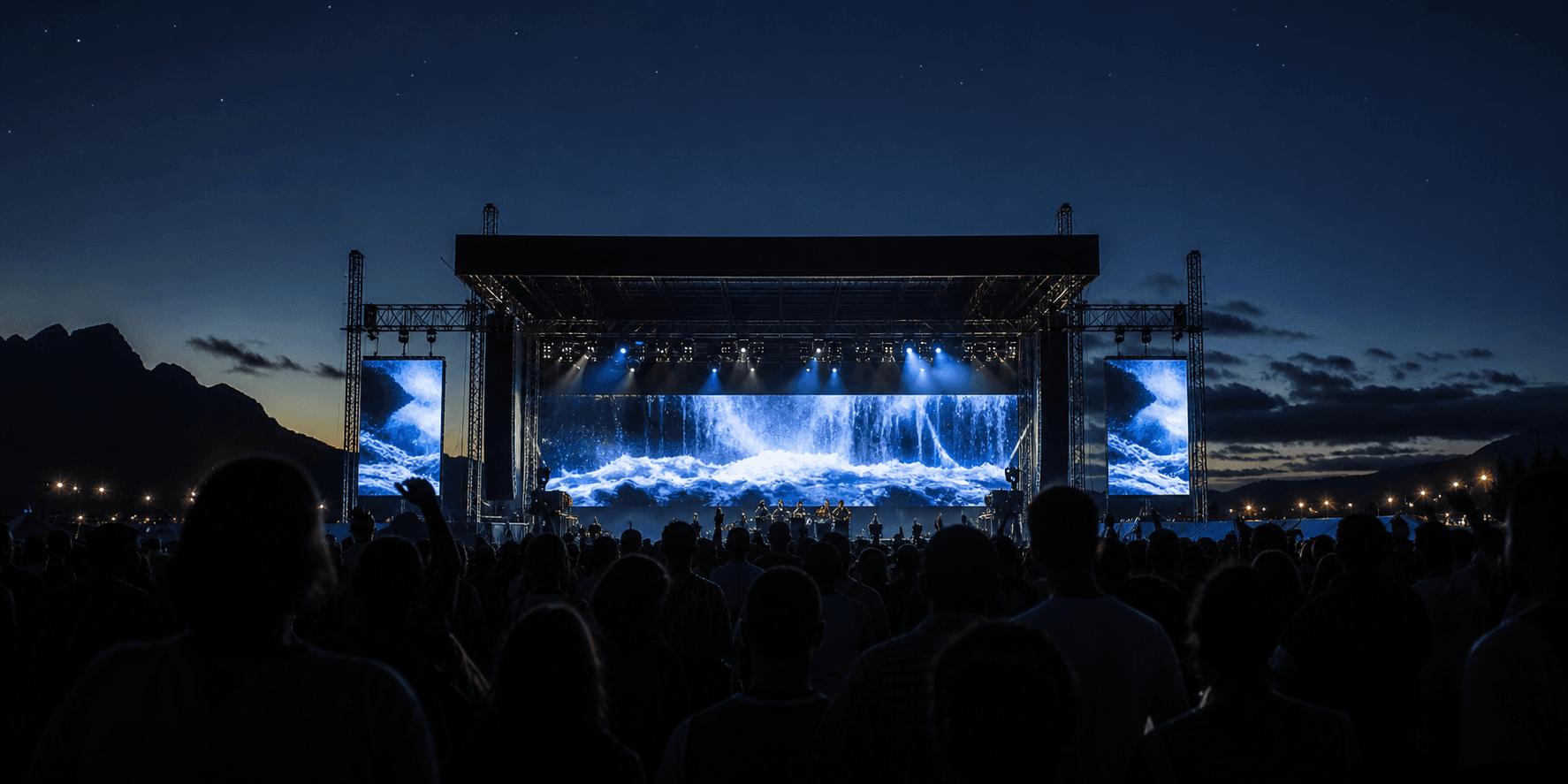
Large outdoor concert stage at blue hour with modular LED walls and an audience
Outdoor concerts & touring

Built before doors. Gone before sunrise.

At a concert the screen is only half the product. The other half is everything that lets a crew build it safely, repeatably and on time.

An outdoor show asks a wall to fight distance, changing daylight, wind and weather while remaining camera-clean for the live cut. The main screen carries scale; side screens carry faces. Their pitch can be coarser than an indoor wall because nobody is standing a metre away, but brightness and structural discipline cannot be compromised.

Tour economics live in cabinet mass, latch speed, curve repeatability and the number of spares that travel. A cabinet that saves fifteen seconds at every connection gives hours back across a tour. Ground support, flown loads and ballast must be engineered for the actual site—not copied from the last show.

The deciding specification

Safe build time and daylight service brightness, measured at show conditions.

Typical pitch
P2.6–P4.8

Main wall and IMAG sightlines differ

Brightness
4,000–6,000 nits

Daylight service, dimmed after dusk

Mechanics
Touring frame

Fast locks, curves and replaceable corners

The honest caveat

“Outdoor rated” is not a structural calculation. Wind loading, rigging, drainage and emergency lowering remain site-specific engineering work.

04Corporate & architectural spaces
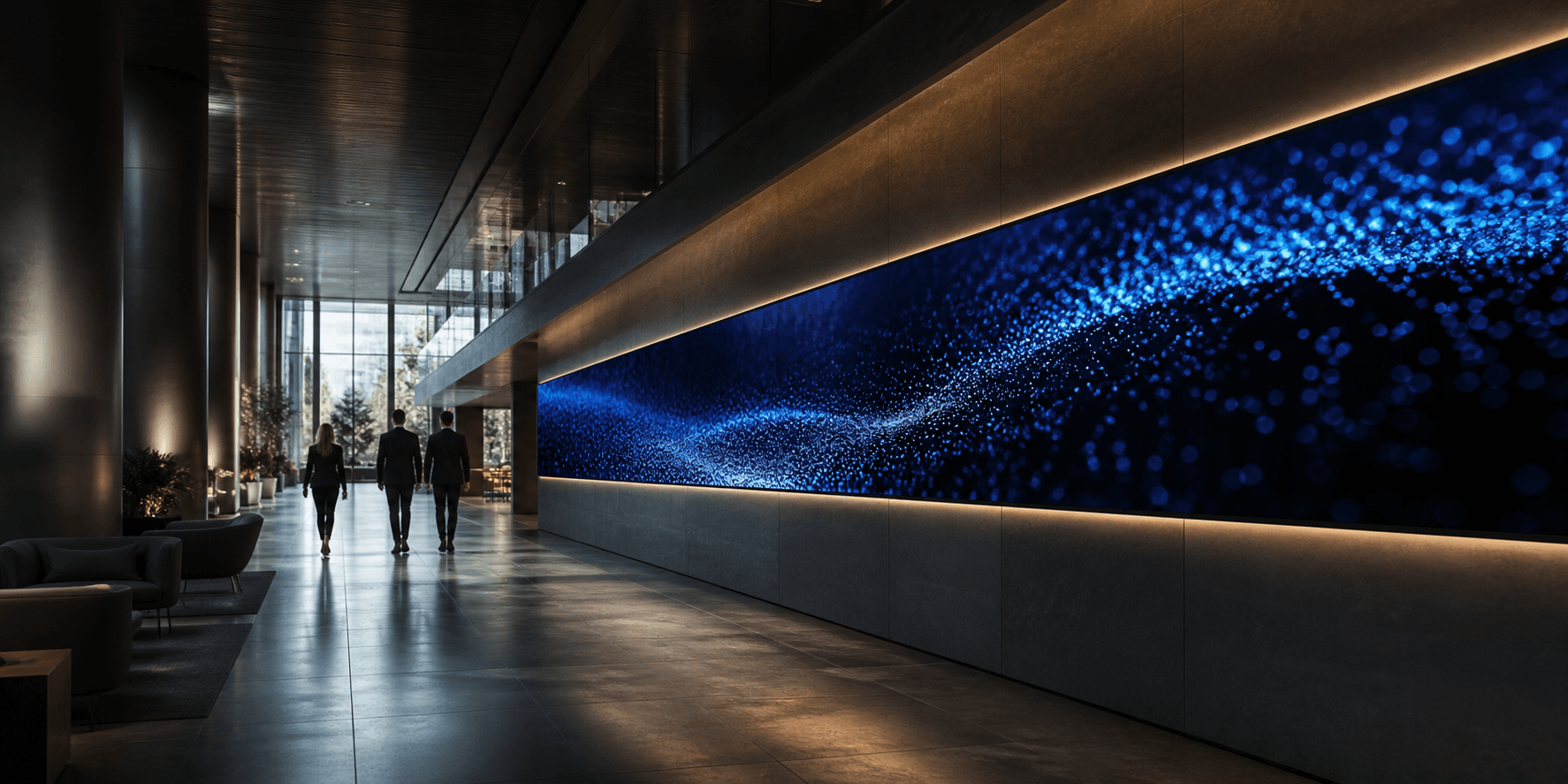
Premium corporate lobby with a long panoramic LED wall integrated into the architecture
Corporate & architectural spaces

A wall that changes how the room feels.

The strongest corporate displays do not behave like enlarged televisions. They become a material in the architecture: light, depth and motion at building scale.

In a lobby, boardroom or innovation centre, the wall is seen for hours and inspected from close range. Seams, uneven black levels and over-bright content become part of the interior whether the architect intended them or not. Fine pitch matters—but calibration, mounting flatness and content restraint matter just as much.

Plan service routes before the joinery is signed off. A fully front-serviceable wall can sit against a core; a rear-service wall needs a passage that changes the floor plan. Then commission content for the shape that was actually built. A panoramic ribbon deserves spatial work, not a stretched presentation deck.

The deciding specification

Mounting flatness and black-level uniformity at the closest public viewpoint.

Typical pitch
P0.9–P1.8

Close inspection rewards finer pitch

Service level
600–1,200 nits

Driven by glass and solar load

Access
Front service

Coordinate with architecture early

The honest caveat

A spectacular wall with generic looped content becomes expensive wallpaper. Budget for an ongoing content language, not only the opening film.

05Broadcast & virtual production
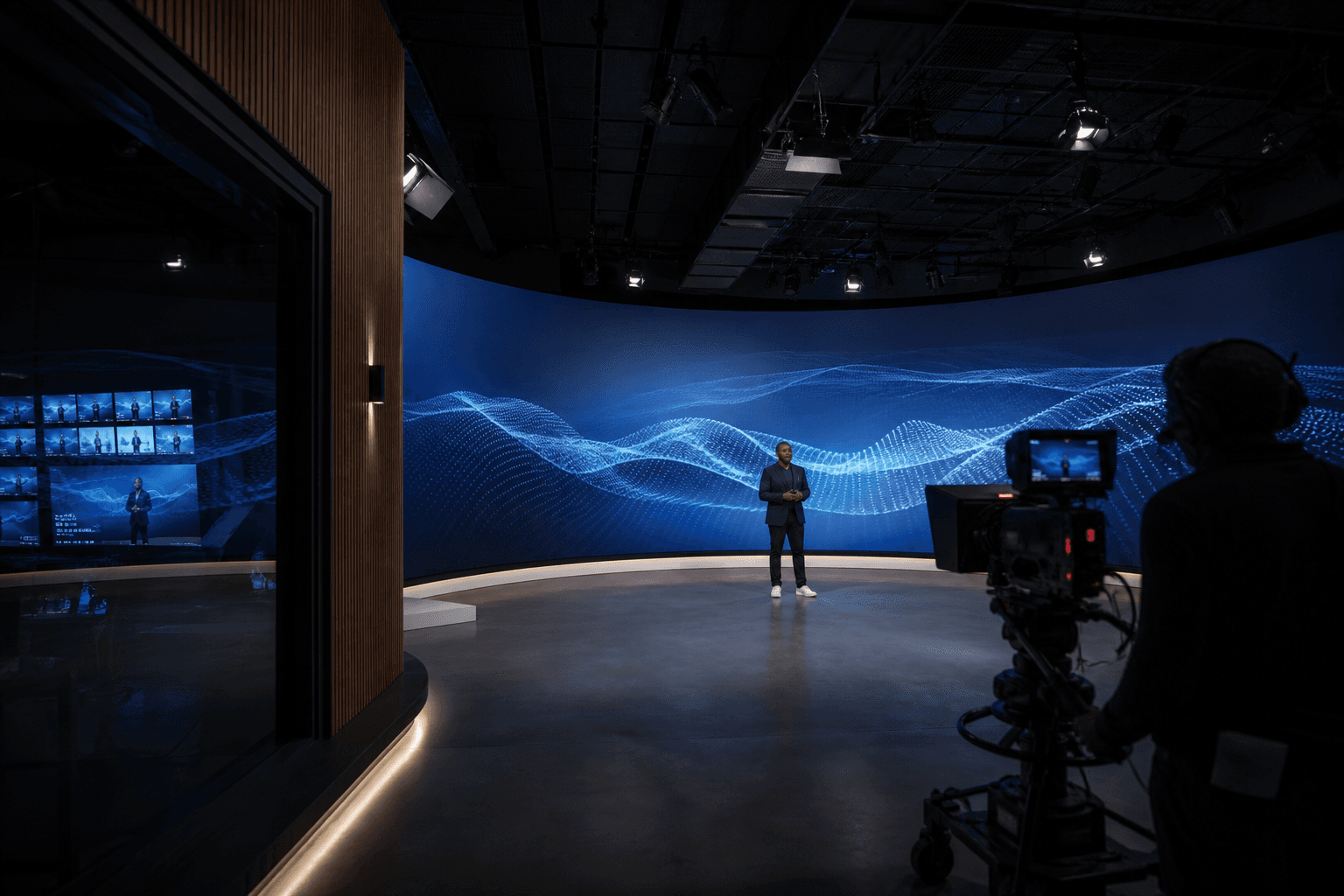
Broadcast presenter in front of a curved fine-pitch LED studio wall with a camera in the foreground
Broadcast & virtual production

Clean to the camera. Convincing to the eye.

A studio wall has two audiences—the viewer in the room and the sensor in the camera. The sensor is considerably less forgiving.

Refresh rate, scan behaviour and shutter timing decide whether the wall is usable before colour is even discussed. A display can look perfect to the presenter and produce rolling bars, torn frames or moiré on air. Camera tests must happen with the actual body, lens, shutter and frame rate planned for production.

For virtual production, the cabinet is one part of a larger timing system: genlock, processing latency, frame remapping, tracking and colour management all meet at the lens. For news and presentation studios, a simpler calibrated wall can still replace physical sets with one continuous, rapidly changeable environment.

The deciding specification

A clean camera test at the fastest shutter and tightest framing the production will use.

Visual refresh
≥ 7,680 Hz

Verify on camera, not on a datasheet

Typical pitch
P0.9–P1.5

Lens, focus and framing set the limit

Pipeline
Genlocked

Processor, camera and render clock aligned

The honest caveat

A “broadcast-ready” cabinet does not make a virtual-production system. Tracking, render, processing and colour science still need one accountable integrator.

06Transport, civic & outdoor public spaces
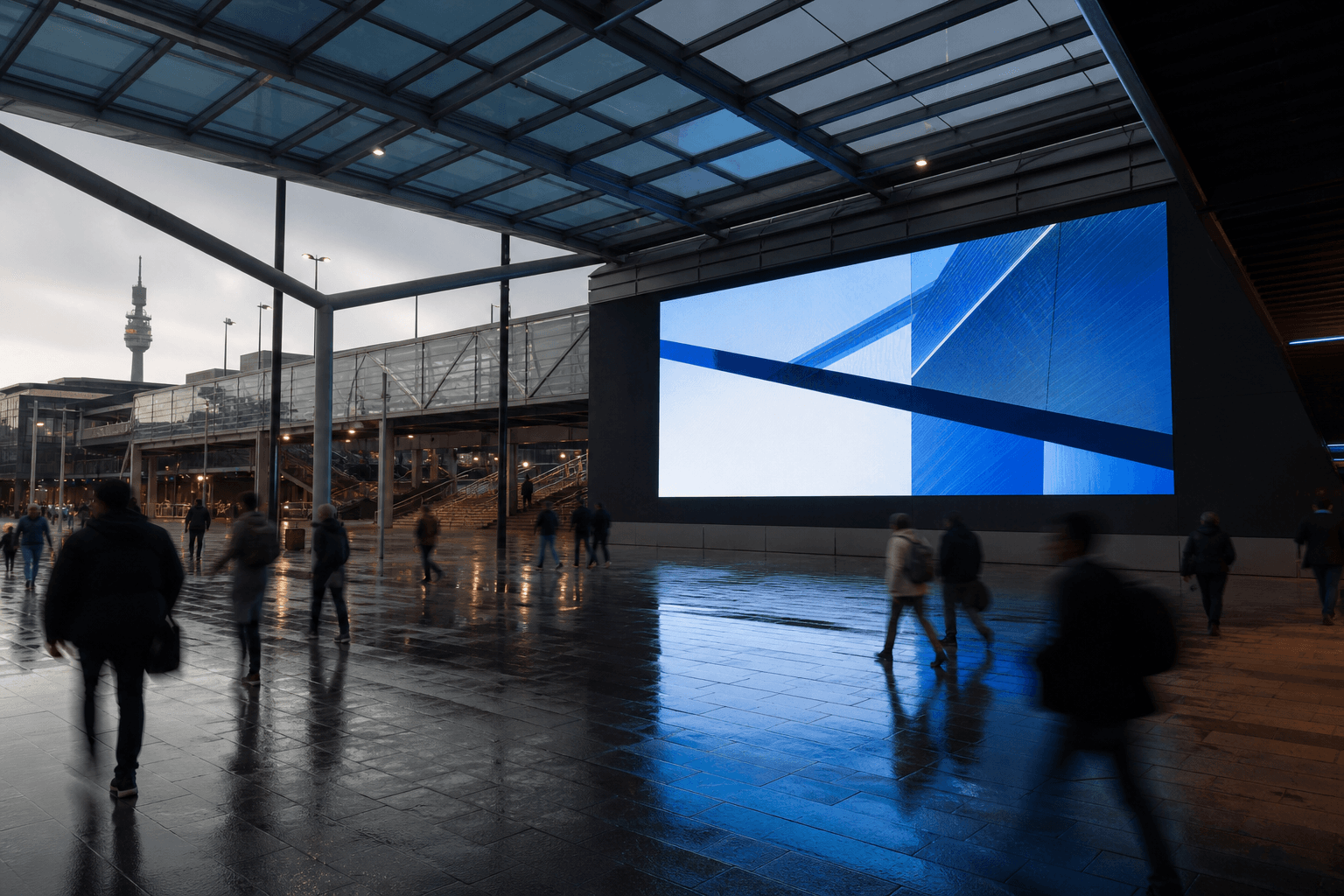
Weatherproof LED display in a modern Johannesburg transport concourse after rain
Transport, civic & outdoor public spaces

Visible in rain. Quiet at midnight.

Public displays must remain useful through sun, rain, distance and years of operation—then dim far enough at night to respect the people around them.

A transport or civic screen is infrastructure before it is media. The image must be legible from the decision point, not merely impressive from directly below. That sets character size, screen area and pitch. Uptime, safe access and remote monitoring determine whether the installation still works after the launch team has left.

Specify ingress protection on both faces, corrosion resistance for the environment and a brightness schedule tied to an ambient sensor. The mounting steel needs real wind-load and drainage calculations. For passenger information, include fallback states and redundant signal paths—the screen may be part of how people move safely.

The deciding specification

Legibility at the longest decision sightline, under the brightest expected daylight.

Typical pitch
P4.8–P10

Distance makes size more valuable than density

Peak output
6,000–10,000 nits

Ambient-controlled for night operation

Ingress
IP66 both faces

Ask for the rear rating in writing

The honest caveat

Peak brightness without automatic dimming creates glare, complaints and premature ageing. Day and night are different operating modes.

Your room is the seventh use case

Bring us the sightline, the daylight and the wall.

We will tell you what the display needs to be—and just as importantly, what it does not need to be.