Skip to content
Use casesChurches & houses of worship

An LED wall that serves the room, not itself.

How to specify an LED wall for a church sanctuary: pixel pitch, daylight contrast, camera performance, front service access and content formats.

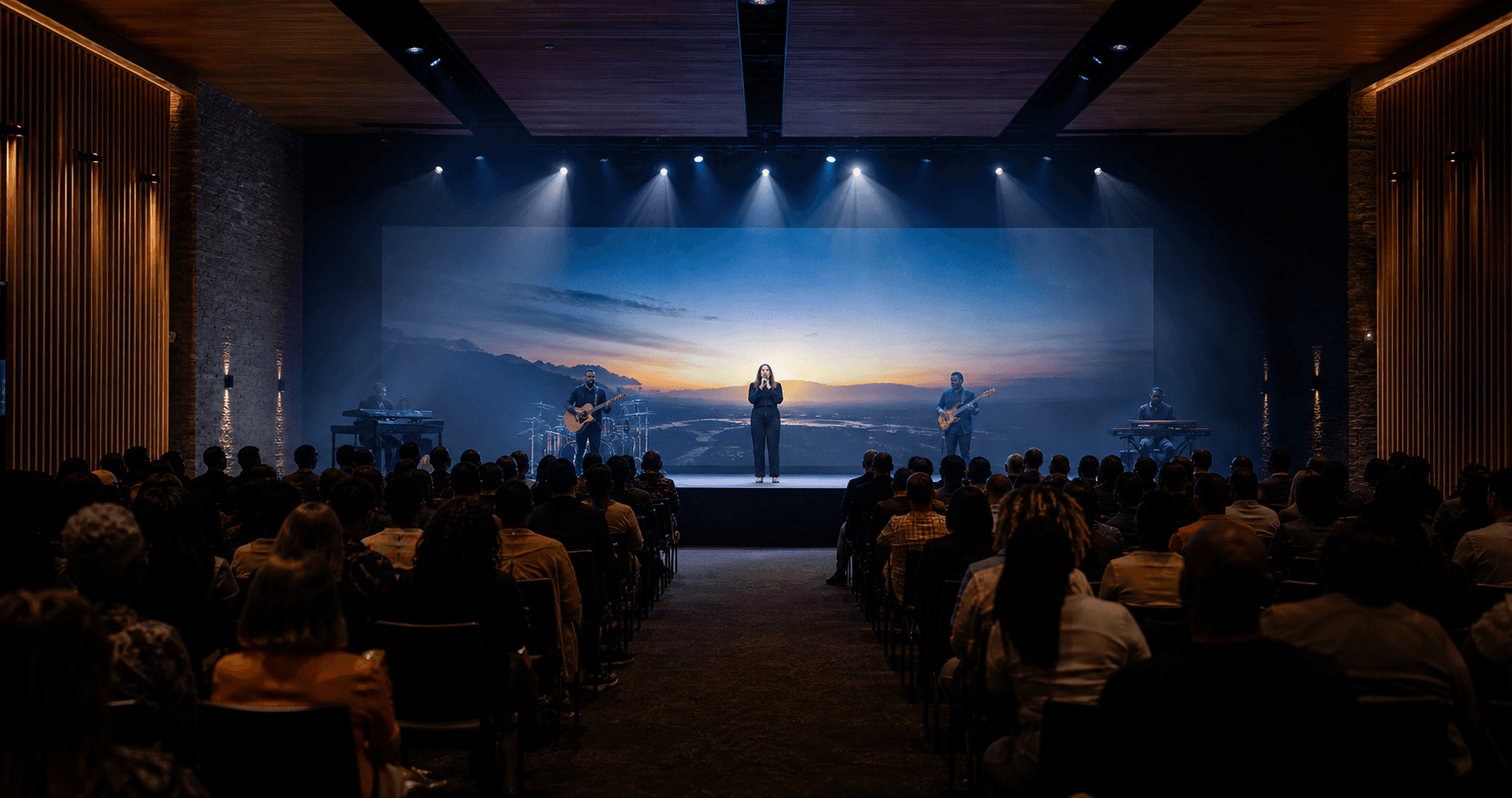
Contemporary church sanctuary with a wide LED wall behind the worship stage

Starting verdict

For most medium and large sanctuaries, begin with Core between P1.8 and P2.6, then let the nearest seat and house-light level decide the exact cabinet.

Field film / 00:18

The wall begins before first light.

Three technicians. One sanctuary. A complete front-facing cabinet build compressed into eighteen seconds.

01 / Structure02 / Formation03 / First light
Starting pitch
P1.8–P2.6

Nearest regular seat sets the limit

Service brightness
500–900 nits

Measured with house lights in use

Refresh
≥ 3,840 Hz

Test with the actual IMAG cameras

Access
Front service

No hidden passage behind the platform

01

Begin with the congregation, not the stage design

Measure the nearest and furthest occupied seats. The nearest seat determines when pixel structure becomes distracting; the furthest determines how large lyrics and faces need to be. A wide wall may look impressive in an elevation but still fail if the content safe area sits behind musicians, lecterns or lighting positions.

The strongest sanctuary layouts give live camera, lyrics and visual atmosphere distinct zones. That can be one 16:9 canvas, a panoramic format or a central screen with carefully justified side surfaces. The right geometry follows the service, not a catalogue photograph.

02

Daylight and camera exposure pull in opposite directions

Clerestory glazing and bright front light demand contrast. Cameras, however, expose for faces and can turn an over-driven display into a clipped rectangle. Specify the normal service level, not only peak output, and commission presets for speech, worship, blackout and daylight.

Run a camera test before sign-off. Use the body, lens, shutter and frame rate the production team actually operates. A generic “camera friendly” line on a datasheet is not evidence that the wall and camera will cooperate.

03

Design maintenance into the platform

Most church walls sit against architecture with no rear corridor. Front-removable modules, power supplies and receiving cards let a technician repair the wall without dismantling stage finishes. Keep ventilation paths, isolation and safe access outside the visible canvas.

Questions before specification

The useful answers.

What pixel pitch is best for a church LED wall?

P1.8 to P2.6 is a common starting range, but the closest occupied seat decides. A larger room can often use a coarser, more economical pitch with no visible penalty.

Is LED better than projection for a church?

LED is usually stronger where daylight, shadows or throw distance compromise projection. A genuinely dark, smaller room may still be better served by a good laser projector.

Can the same wall work for lyrics and live camera?

Yes, provided the canvas layout, processing and camera refresh performance are designed together and tested at the intended exposure settings.