Skip to content
Use casesTransport, civic & public environments

Infrastructure that happens to emit light.

A guide to outdoor public LED displays for transport and civic environments: legibility, IP ratings, brightness control, access and redundancy.

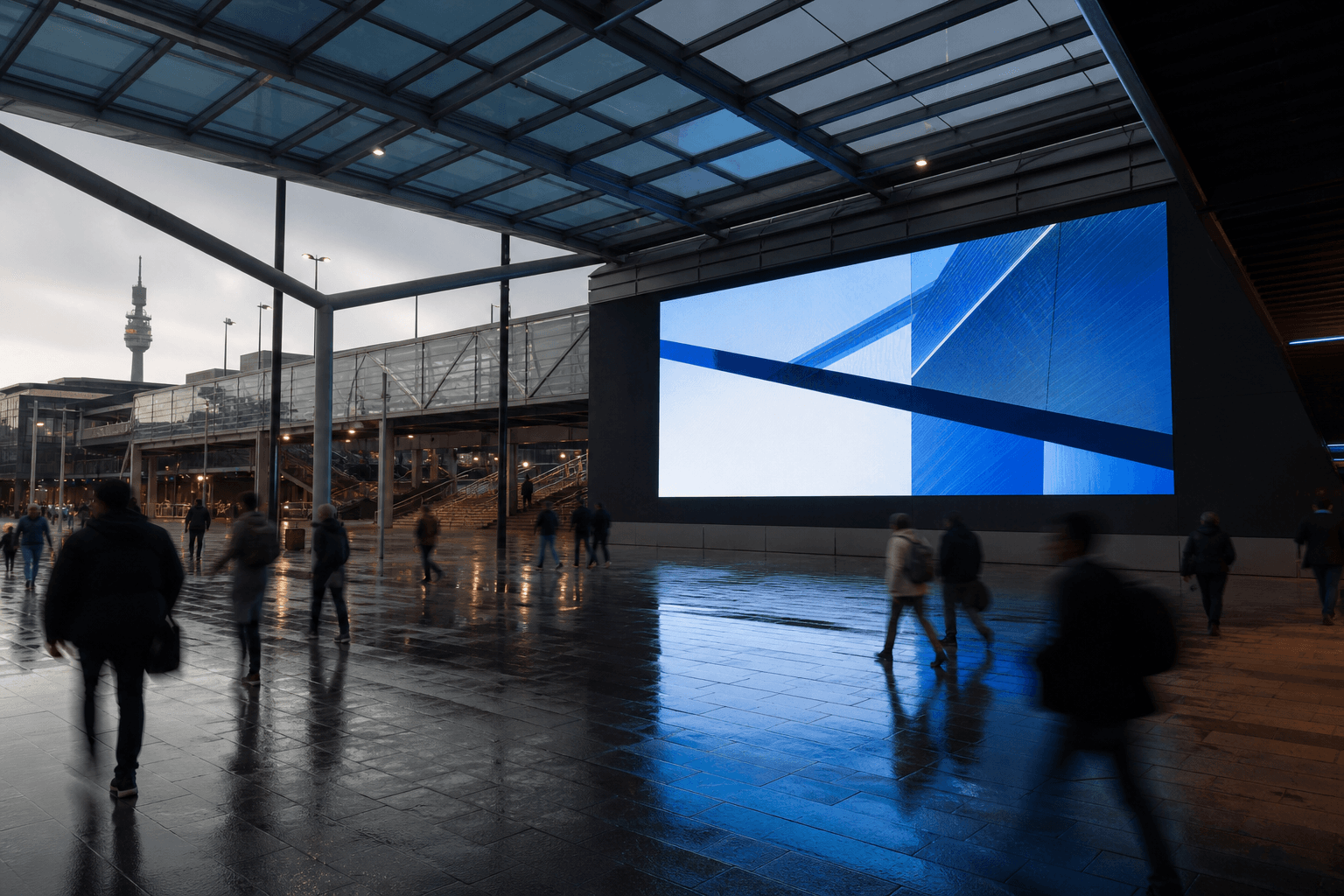
Weatherproof LED display in a public transport concourse after rain

Starting verdict

Begin with Beacon P4.8–P10 and IP66 on both faces, then let the longest decision sightline and daylight condition set area and output.

Starting pitch
P4.8–P10

Distance rewards physical scale

Peak output
6,000–10,000 nits

Ambient-controlled by time of day

Ingress
IP66 / IP66

Require front and rear ratings

Operations
Remote monitored

Faults visible before users report them

01

Design from the decision point

For transport and wayfinding, identify where a person must read and act. Character height, screen area and contrast follow that sightline. Pixel pitch is secondary once individual pixels have merged at the viewing distance.

Test for low sun, rain reflections and oblique viewing—not only the straight-on rendering used for approval.

02

Ask what the rear face can survive

Many products advertise the front ingress rating while the rear is less protected. Wind-driven rain, condensation, salt, dust and maintenance exposure reach both sides. Require written ratings for cabinets and connections in the actual orientation.

Design drainage, isolation, corrosion protection and safe maintenance access with the structure.

03

Night is a separate operating mode

A daylight-bright screen must dim deeply after dark. Ambient sensing, scheduled limits and content luminance protect drivers, neighbours, power consumption and LED life. For critical information, specify redundant signal and fallback states.

Questions before specification

The useful answers.

What does IP66 mean for an LED display?

IP66 indicates dust-tight construction and protection against powerful water jets. Confirm that the rating applies to both front and rear faces and the installed connections.

How bright must an outdoor LED screen be?

Peak capability often ranges from 6,000 to 10,000 nits, but actual output should track ambient conditions and dim substantially at night.

Does a distant outdoor screen need fine pitch?

Usually not. Once pixels merge at the viewing distance, additional physical area and appropriate character size create more value than finer pitch.